Wednesday, July 26, 2017
Review of York by Laura Ruby
This is sort of MG/young YA. The author writes 13-year-old protagonists who are more what the parents of 10-year-olds want their kids to be at 13 than what 13-year-olds are actually like. These 13-year-olds, for example, have no hormones whatsoever and behave like responsible 10-year-olds. That part is a bit bizarre.
The plot is sort of Dan Brown for grade schoolers also. Our hormoneless trio races from place to place in an alternate reality NYC wherein things are solar powered and clean, a BETTER NYC, if you will. Each time they easily find clues to help them in their goal of saving the old, history-filled apartment building they call home. The kids do not grow, change, or mature. This is not Harry Potter, folks.
That being said, the pacing is good. The plot rips along at a very good rate until.....WAIT FOR IT.....until there is no real ending because.....SEQUEL!!! I mean; why write a good book for kids if you can stretch it out with filler and make a SERIES, right?
Sigh.
Look; this could have been really good. I enjoyed much of it (the setting, for instance, is well-explained), but I won't read the sequel.
If you put this next to anything by Zilpha Keatley Snyder, Beverly Cleary, or Judy Blume, it pales.
On the other hand, if your kid wants to read it, encourage her/him. It's far, far better than RL Stine or endless rounds of phone games.
If you're an adult that loves YA, I'd suggest checking this out from the library (as I did) rather than shelling out bucks for it.
Friday, July 7, 2017
Review: The Utah Shakespeare Festival 2017 Season
UPDATE: I returned to the Festival on August 5, seeing Midsummer a second time and watching two newly added shows, Shrew! and Long-Lost First Play. This review has now been updated to include this information.
I go to the Utah Shakespeare Festival almost every year, and most years, I review the plays here on this blog. I skipped doing the reviews in 2016 because the Festival had new buildings and a weird new schedule, and I ended up going so late in the season that it seemed pointless to post reviews. But for 2017, I attended all preview shows, so the season is just barely starting, and my reviews may be helpful.
First, let me review the festival itself.
This is the 56th season of the festival in Cedar City, Utah (roughly a 3 1/2 hour drive from Salt Lake City). Cedar City is a college town, smallish, but with plenty of lodging and easy, free parking for the festival (completely unlike the idiotic situation for the festival in Ashland, Oregon). Most years, the festival does three Shakespeare plays (often one history, one comedy, one tragedy --- but this is not the case this year) and three other plays, which generally include a musical, a kid-friendly play (some years, this is the musical, such as last year, when Mary Poppins was presented), and either a serious drama or a non-Shakespeare comedy. The ticket prices are reasonable, and the schedule is arranged so that theatre -goers may see all 6 plays in 3 days (except last year, when things got weird).
The festival has won many awards, including a Tony, and it attracts top-notch stage actors. But the best part of it is the community feel. Every morning after the plays, seminars are held. In the first week, the directors of the plays come to these and answer audience questions, but throughout the season, actor seminars are also held. Furthermore, the actors, the artistic director, and the festival founder himself mingle with the patrons. It's perfectly fine for ordinary patrons to approach an actor who is walking about on site; they are not stand off-ish at all. There are also classes and camps and tours designed for different ages and interests; one can take a week-long course in theatre tech or a seminar in stage combat or simply go on a guided tour of the backstage areas.
However......
The festival has had to move to all-new buildings, and this hasn't really been great. The old theatre looked like a Tudor building on the outside and was shaded by huge, old trees on a grassy area of the Southern Utah University campus. The new theatre is concrete and industrial. It looks like a product of Cold War Russia, all grey, lifeless, and designed to suck out one's soul. Until 2016, the morning seminars were held in a grove of tall pine trees with a view of a grassy, park-like space. Now the seminars are held in a hot, mostly unshaded area between the theatres. It's concrete and gravel and has all the ambience of a parking lot.
But it's still worth it. The plays are wonderful and the people of the festival are fantastic. I love it.
Below are my reviews of the individual plays of the 2017 season:
A Midsummer Night's Dream:
Do NOT miss this one!!!
Wow.
This Midsummer is set in the 1920s, with a teal-green Art Deco Athens and a glitzy chrome Yin/Yang forest. The costumes are FREAKIN' GORGEOUS! (See Hippolyta above.) The light cues match the magic of the fairies.
It's often that a director chooses to cast the same actors for Theseus and Hippolyta as for Oberon and Titania, and this is true with this production. However, the director also has the same actors who play the Rude Mechanicals also play Titania's following of fairies, and the parallels in color and action are delightful to pick out. The actor playing Puck also plays Philostrate (except she was very ill the day I saw the preview, and her part was read by the assistant director, so I cannot comment on this Puck). Only Nick Bottom (hilarious, by the way) and the lovers play single roles.
This is a superb production. It's funny where it's supposed to be funny. (Yes, I am very familiar with this play.) It's sexy enough without being unfit for kids. (The last time the festival did this play they made it a kids' version and took all the sexuality out of it, which was a shame.) The subtleties between Theseus and Hippolyta work. The physical comedy is spot-on.
In fact, the only thing I didn't like was that Oberon was not a very good-looking guy, and I prefer a handsome King of the Fairies. However, his acting made him wonderful. (And, of course, Melinda Parrett, my very favorite of all the festival women, plays Hippolyta/Titania. She's nothing short of fabulous.)
This play is so good I would happily pay to see it again. And, since this play runs all the way through October, I may very well do that. (Note: the festival also has plays that open later and run later in the season. Obviously, I cannot comment on those. Check Bard.org to learn more about The Tavern, Shakespeare's Long Lost First Play, and How To Fight Loneliness.)
UPDATE: I DID see it again! I went back on August 5, specifically to see the Words Cubed Shrew! and Long-Lost First Play (reviews for which follow at the bottom of this post), and I loved it even more! The addition of Kelly Rogers as Puck made it even more fabulous, as she is wonderful. Also, numerous subtle-but-effective bits of physical humor have been added. This show is amazing, and it runs through October. Do NOT miss it!!
As You Like It:
As You Like It is a delightful comedy, but a lot of non-English teacher types don't know much about it, and some people find it a bit confusing. That, however, is no reason to miss this production: Bard.org has play summaries and introductions, as does the printed program, and there is a play orientation (free) before every single performance of every play at the festival. The plot is convoluted, but it's a fun, light-hearted play, and this production is good.
OK, the set is a bit monotonous, but once the scene changes to the Forest of Arden, it is very pretty, if unchanging.
The director has cut a lot of this play and moved a few things around, but it works. The costumes are good (Have a look at Rosalind/Ganymeade's jacket above. Isn't it great?) and the acting is very good.
Rosalind is played by Cassandra Bissell (who also plays Helena in Midsummer and is fabulous there as well), an actor who is only second to Melinda Parrett (see Midsummer) in my opinion of women often appearing at the festival. She is brilliant in this role. And Jeb Burris is a fabulous and very believable Orlando. Michael Elich's take on Jacques is entirely different than I've ever seen before; he plays him as a sarcastically depressed man, and this makes his insult war with Orlando a bit of theatre perfection.
This is a very good production of As You Like It. If you like live theatre, don't miss it.
Romeo and Juliet:
To be honest, since I taught 9th grade English (usually multiple periods thereof) for 28 years, it is very likely that I know Romeo and Juliet better than either the director or actors of the play; I've simply read/seen it literally scores of times.
I know every single line that was cut -- and I got the director laughing after the seminar when I teased him about cutting most of Mercutio's filthy jokes. And I've seen dozens of different interpretations of the play.
Thus, I feel very qualified to review this one.
Overall? It's pretty good.
The set was dull. Someone decided it would be a good idea to use the same set for the first part of As You Like It, all of R& J, and presumably also Shakespeare In Love. It's boring. The only interesting things are Friar Lawrence's cell, Juliet's bed, and the tomb -- although the latter is still really stark and leaves out Tybalt.
The costumes, however, make up for the lack of set. They are rich and delightful. As many directors do, this one decided to stay with the color-coding chosen by Zefferrelli in the 1968 movie, and so the Capulets are in reds and other warm colors, while the Montagues are in cool blues, greens, and purples.
And the acting......
Betsy Muscavero looks about 15 for this production. She plays a very innocent Juliet, which is different from what we usually get (the last time the festival did R&J, the gal who played Juliet did so as a headstrong, sulking, rebellious teen). She is supremely convincing in gesture and expression. It is truly HER show, HER story.
Romeo, on the other hand, is played by Shane Kenyon, who has a receding hairline and looks about 35. He played Romeo as a nerd, the sort of guy who plays a lot of video games and has trouble talking to real people. It was awful. There was nothing attractive or romantic about him at all.
Mercutio, played by Jeb Burris (who was amazing as Orlando in As You Like It) was manic/depressive. The director told me at the seminar that they wanted to make him jealous of Romeo's attention to Rosaline (but they totally left out any homoerrotic overtones). It worked, but it meant that they had to kill all the humor in Mercutio's lines. All in all, he was not my favorite.
Benvolio looked like Gene Kelly. I totally wanted him to start dancing. He was OK. They didn't make him a coward -- but they didn't make him much of anything else either. He was better looking than Romeo, though.
The parents are very interesting in this production, and Friar Lawrence is very good.
On the whole, it's definitely worth seeing --- but don't expect to fall in love with Romeo!
Guys and Dolls:
Guys and Dolls is a fun musical based on a set of stories by Damon Runyan (I've read them; they're not my favorites). It's set in 1950s NYC and focuses on problems of Nathan Detroit (played by the KING of Comedy, Quinn Mattfield). Nathan makes his questionable living by running a floating crap game, but he can't find a place to hold that night's game, and Big Jule is in town -- and you don't mess up Big Jule's crap game. Nathan makes a bet with the high rolling Sky Masterson (played by the amazing Brian Vaughn, the festival's artist director) for $1000 in order to "rent" the Biltmore Garage for the crap game, a bet that Sky cannot get a girl of Nathan's choosing to go on a dinner date with him. Sky's problems begin when Nathan chooses Sarah Brown, the leader of the local Save-a-Soul Mission. Meanwhile, Nathan's problems get more intense when his fiance of 14 years, Miss Adelaide (played by my favorite, Melinda Parrett) begins to insist on marriage.
I was in a community theatre production of this play about 15 years ago, so I know it well, and I LOVED this version. The set is great, the costumes are color-coded to help the audience keep track of all the gamblers, the singing is good, the jokes are all there, the choreography is wonderful, and the acting! Well, how could it be anything less than stellar with the combination of Brian Vaughn, Melinda Parrett, and Quinn Mattfield? They are incredible.
This is a fun, fun show. Don't miss it.
Treasure Island:
This is the kids' show for this year, and it's pretty good.
Sceri Ivers plays Jim Hawkins in an adaptation that stays very close to the actual novel by Robert Louis Stevenson. I personally thought that Ivers' costume detracted from her being believable as a 12-year-old, active boy (it was bulky and made her look fat and slump-shouldered, more like a teen couch potato than the Jim Hawkins who climbs the mast of the ship), but I was told my comments in the seminar would be passed to the director, so that issue may be resolved.
The set is exceptionally clever and has many levels. (See photo.) And a real treat is that a good deal of live music is included.
Overall, this is not my favorite thing at the festival, but it was well done and I do not regret buying a ticket.
Shakespeare In Love:
To be honest, I didn't go to this one because I loathed the movie and still hate how the story confuses people who don't know anything about Shakespeare. Most people who saw this play told me I was stupid for missing out. I'll leave you to decide if you want to see it or not. (I will state that the FABULOUS Quinn Mattfield plays Shakespeare himself; that may be enough to justify the purchase of tickets.)
UPDATE: The Utah Shakespeare Festival has long supported emerging playwrights through what is now called their Words Cubed program. Until this year, I had never attended one of these dramatic readings done by professional actors. However, I really wanted to see what playwright Amy Freed had done with my least favorite Shakespeare play, The Taming of the Shrew, so I drove back to Cedar City to see it (plus Midsummer again and Long-Lost). (Note: it was only $10.00.)
I will be honest: I don't think Freed solved the main problem of the play for modern audiences, which is that the plot condones the "training" of women to be what men want. Yes, Freed solved various other problems in this early work of the Bard's, such as making Petrucchio far less of a jerk and giving an explanation as to why Vincencio behaves as he does, but Freed's Petrucchio STILL molds and trains Kate into the wife he wants; we are still left with the message that feisty, independent Kate is still somehow "wrong" and that only a man can change her. (Insert eye roll and barf emojis mentally here, please.)
That being said, here's what was marvelous: The experience itself. The actors did not just sit in chairs and read; they improvved a great deal, had necessary props and costume bits, and made this a fabulous bit of entertainment. Also, the audience members get to talk to the playwright and the director, giving feedback about this work, which is a great experience. (Note: the director of this play was arrogant and condescending, so that was not pleasant. But Ms. Freed was very interesting.)
This particular dramatic reading will run again Aug. 30 and Sept. 1. If you're at the Festival, consider spending the ten bucks to experience this.
UPDATE: The Festival has now opened Shakespeare's Long-Lost First Play, and I went to see it on August 5.
(Photo: Beatrice and Richard III take a selfie while Puck looks on.)
I loved the 90s play by the Reduced Shakespeare Company, "The Complete Works of William Shakespeare, Abridged," the premise of which is that a troupe of three male actors attempt to give the audience a condensed version of every single one of the Bard's plays, all in 2 hours. It's hilarious.
Long-Lost First Play isn't quite as good.
The premise of this is that 3 male actors find a massive script buried with Richard III's body in a parking lot (yes, that's anachronistic.), but since the play would be four days long, they attempt to condense it. Many of Shakespeare's famous characters are included, under the guise that Puck, a fairy from Midsummer, and Ariel, a fairy from the Tempest (dressed as Ariel the Little Mermaid, a joke that is funny the first time but quickly grows stale), are having a mischief war with each other, trying to change the plays. The result is mixed.
The acting in this is phenomenal. I was amazed at the way these three guys kept it up. (Note: actor Marco Antonio Vega had already been in Shrew! and Midsummer the day I saw this. He did three plays in one day -- good thing he's young and energetic!)
The script is kind of a problem. For one thing, I seriously doubt that anyone who is not well-versed in Shakespeare would get more than 30% of the jokes. I'm a total Shakespeare freak, yet the script at least twice referred to Shakespeare writing a play featuring Don Quijote and thus inspiring Cervantes. I'd never heard of this before (and plan to look it up). There was one joke about the "coast of Bohemia" where my laugh was the only audible one, so I'm guessing that reference to Winter's Tale went over most people's heads.
Another problem for some people would be the humor. It ranged from the exceptionally clever to the incredibly lame. On the one hand, we got the delightful pairing of the ever-indecisive Hamlet with the super-pushy Lady MacBeth (hilarious!) and again the scene wherein Hamlet tells all the players how to do their jobs countered with Nick Bottom telling all his fellow actors how he would do things the best (so clever!). Then we get King Lear fart jokes on a third-grade level (uhhhhh, not really clever or funny).
Also, some of the jokes went into very questionable stereotyping, such as "all Arabs are part of the Taliban or ISIS" and "all feminists are ugly lesbian man-haters." These made me cringe, and there were far better ways they could have handled the Caliban jokes and getting Juliet to use Shakespeare's insults.
So, my recommendation on Long-Lost is this: do not miss it if 1) you know your Shakespeare, 2) you do not mind sexual humor (because there's a lot of it, much of it just as funny as the sexual jokes the Bard put into his own stuff), and 3) you're not upset about getting wet (put your cell phones away when they tell you to; they do the Tempest). Do NOT go to this play if 1) you're a Bard newbie or 2) you're the sort who flinches if someone makes an off-color remark. This is NOT the play to see for a Relief Society outing, people.
In summary, there are no losing plays at the festival this year, but if you are short on time and/or money and want to know the best, my suggestions in order of what to see would be as follows:
1) Midsummer
2) Guys and Dolls
3) As You Like It
4) Romeo and Juliet
5) Long-Lost (if you meet the above qualifications)
5) Treasure Island
In other words, if you can only see one play, make it Midsummer, if you can see two, let them be Midsummer and Guys and Dolls, and so forth.
Find tickets, photos, a calendar, play summaries, casts, directions, etc. at Bard.org.
I go to the Utah Shakespeare Festival almost every year, and most years, I review the plays here on this blog. I skipped doing the reviews in 2016 because the Festival had new buildings and a weird new schedule, and I ended up going so late in the season that it seemed pointless to post reviews. But for 2017, I attended all preview shows, so the season is just barely starting, and my reviews may be helpful.
First, let me review the festival itself.
This is the 56th season of the festival in Cedar City, Utah (roughly a 3 1/2 hour drive from Salt Lake City). Cedar City is a college town, smallish, but with plenty of lodging and easy, free parking for the festival (completely unlike the idiotic situation for the festival in Ashland, Oregon). Most years, the festival does three Shakespeare plays (often one history, one comedy, one tragedy --- but this is not the case this year) and three other plays, which generally include a musical, a kid-friendly play (some years, this is the musical, such as last year, when Mary Poppins was presented), and either a serious drama or a non-Shakespeare comedy. The ticket prices are reasonable, and the schedule is arranged so that theatre -goers may see all 6 plays in 3 days (except last year, when things got weird).
The festival has won many awards, including a Tony, and it attracts top-notch stage actors. But the best part of it is the community feel. Every morning after the plays, seminars are held. In the first week, the directors of the plays come to these and answer audience questions, but throughout the season, actor seminars are also held. Furthermore, the actors, the artistic director, and the festival founder himself mingle with the patrons. It's perfectly fine for ordinary patrons to approach an actor who is walking about on site; they are not stand off-ish at all. There are also classes and camps and tours designed for different ages and interests; one can take a week-long course in theatre tech or a seminar in stage combat or simply go on a guided tour of the backstage areas.
However......
The festival has had to move to all-new buildings, and this hasn't really been great. The old theatre looked like a Tudor building on the outside and was shaded by huge, old trees on a grassy area of the Southern Utah University campus. The new theatre is concrete and industrial. It looks like a product of Cold War Russia, all grey, lifeless, and designed to suck out one's soul. Until 2016, the morning seminars were held in a grove of tall pine trees with a view of a grassy, park-like space. Now the seminars are held in a hot, mostly unshaded area between the theatres. It's concrete and gravel and has all the ambience of a parking lot.
But it's still worth it. The plays are wonderful and the people of the festival are fantastic. I love it.
Below are my reviews of the individual plays of the 2017 season:
A Midsummer Night's Dream:
Do NOT miss this one!!!
Wow.
This Midsummer is set in the 1920s, with a teal-green Art Deco Athens and a glitzy chrome Yin/Yang forest. The costumes are FREAKIN' GORGEOUS! (See Hippolyta above.) The light cues match the magic of the fairies.
It's often that a director chooses to cast the same actors for Theseus and Hippolyta as for Oberon and Titania, and this is true with this production. However, the director also has the same actors who play the Rude Mechanicals also play Titania's following of fairies, and the parallels in color and action are delightful to pick out. The actor playing Puck also plays Philostrate (except she was very ill the day I saw the preview, and her part was read by the assistant director, so I cannot comment on this Puck). Only Nick Bottom (hilarious, by the way) and the lovers play single roles.
This is a superb production. It's funny where it's supposed to be funny. (Yes, I am very familiar with this play.) It's sexy enough without being unfit for kids. (The last time the festival did this play they made it a kids' version and took all the sexuality out of it, which was a shame.) The subtleties between Theseus and Hippolyta work. The physical comedy is spot-on.
In fact, the only thing I didn't like was that Oberon was not a very good-looking guy, and I prefer a handsome King of the Fairies. However, his acting made him wonderful. (And, of course, Melinda Parrett, my very favorite of all the festival women, plays Hippolyta/Titania. She's nothing short of fabulous.)
This play is so good I would happily pay to see it again. And, since this play runs all the way through October, I may very well do that. (Note: the festival also has plays that open later and run later in the season. Obviously, I cannot comment on those. Check Bard.org to learn more about The Tavern, Shakespeare's Long Lost First Play, and How To Fight Loneliness.)
UPDATE: I DID see it again! I went back on August 5, specifically to see the Words Cubed Shrew! and Long-Lost First Play (reviews for which follow at the bottom of this post), and I loved it even more! The addition of Kelly Rogers as Puck made it even more fabulous, as she is wonderful. Also, numerous subtle-but-effective bits of physical humor have been added. This show is amazing, and it runs through October. Do NOT miss it!!
As You Like It:
OK, the set is a bit monotonous, but once the scene changes to the Forest of Arden, it is very pretty, if unchanging.
The director has cut a lot of this play and moved a few things around, but it works. The costumes are good (Have a look at Rosalind/Ganymeade's jacket above. Isn't it great?) and the acting is very good.
Rosalind is played by Cassandra Bissell (who also plays Helena in Midsummer and is fabulous there as well), an actor who is only second to Melinda Parrett (see Midsummer) in my opinion of women often appearing at the festival. She is brilliant in this role. And Jeb Burris is a fabulous and very believable Orlando. Michael Elich's take on Jacques is entirely different than I've ever seen before; he plays him as a sarcastically depressed man, and this makes his insult war with Orlando a bit of theatre perfection.
This is a very good production of As You Like It. If you like live theatre, don't miss it.
Romeo and Juliet:
To be honest, since I taught 9th grade English (usually multiple periods thereof) for 28 years, it is very likely that I know Romeo and Juliet better than either the director or actors of the play; I've simply read/seen it literally scores of times.
I know every single line that was cut -- and I got the director laughing after the seminar when I teased him about cutting most of Mercutio's filthy jokes. And I've seen dozens of different interpretations of the play.
Thus, I feel very qualified to review this one.
Overall? It's pretty good.
The set was dull. Someone decided it would be a good idea to use the same set for the first part of As You Like It, all of R& J, and presumably also Shakespeare In Love. It's boring. The only interesting things are Friar Lawrence's cell, Juliet's bed, and the tomb -- although the latter is still really stark and leaves out Tybalt.
The costumes, however, make up for the lack of set. They are rich and delightful. As many directors do, this one decided to stay with the color-coding chosen by Zefferrelli in the 1968 movie, and so the Capulets are in reds and other warm colors, while the Montagues are in cool blues, greens, and purples.
And the acting......
Betsy Muscavero looks about 15 for this production. She plays a very innocent Juliet, which is different from what we usually get (the last time the festival did R&J, the gal who played Juliet did so as a headstrong, sulking, rebellious teen). She is supremely convincing in gesture and expression. It is truly HER show, HER story.
Romeo, on the other hand, is played by Shane Kenyon, who has a receding hairline and looks about 35. He played Romeo as a nerd, the sort of guy who plays a lot of video games and has trouble talking to real people. It was awful. There was nothing attractive or romantic about him at all.
Mercutio, played by Jeb Burris (who was amazing as Orlando in As You Like It) was manic/depressive. The director told me at the seminar that they wanted to make him jealous of Romeo's attention to Rosaline (but they totally left out any homoerrotic overtones). It worked, but it meant that they had to kill all the humor in Mercutio's lines. All in all, he was not my favorite.
Benvolio looked like Gene Kelly. I totally wanted him to start dancing. He was OK. They didn't make him a coward -- but they didn't make him much of anything else either. He was better looking than Romeo, though.
The parents are very interesting in this production, and Friar Lawrence is very good.
On the whole, it's definitely worth seeing --- but don't expect to fall in love with Romeo!
Guys and Dolls:
Guys and Dolls is a fun musical based on a set of stories by Damon Runyan (I've read them; they're not my favorites). It's set in 1950s NYC and focuses on problems of Nathan Detroit (played by the KING of Comedy, Quinn Mattfield). Nathan makes his questionable living by running a floating crap game, but he can't find a place to hold that night's game, and Big Jule is in town -- and you don't mess up Big Jule's crap game. Nathan makes a bet with the high rolling Sky Masterson (played by the amazing Brian Vaughn, the festival's artist director) for $1000 in order to "rent" the Biltmore Garage for the crap game, a bet that Sky cannot get a girl of Nathan's choosing to go on a dinner date with him. Sky's problems begin when Nathan chooses Sarah Brown, the leader of the local Save-a-Soul Mission. Meanwhile, Nathan's problems get more intense when his fiance of 14 years, Miss Adelaide (played by my favorite, Melinda Parrett) begins to insist on marriage.
I was in a community theatre production of this play about 15 years ago, so I know it well, and I LOVED this version. The set is great, the costumes are color-coded to help the audience keep track of all the gamblers, the singing is good, the jokes are all there, the choreography is wonderful, and the acting! Well, how could it be anything less than stellar with the combination of Brian Vaughn, Melinda Parrett, and Quinn Mattfield? They are incredible.
This is a fun, fun show. Don't miss it.
Treasure Island:
This is the kids' show for this year, and it's pretty good.
Sceri Ivers plays Jim Hawkins in an adaptation that stays very close to the actual novel by Robert Louis Stevenson. I personally thought that Ivers' costume detracted from her being believable as a 12-year-old, active boy (it was bulky and made her look fat and slump-shouldered, more like a teen couch potato than the Jim Hawkins who climbs the mast of the ship), but I was told my comments in the seminar would be passed to the director, so that issue may be resolved.
The set is exceptionally clever and has many levels. (See photo.) And a real treat is that a good deal of live music is included.
Overall, this is not my favorite thing at the festival, but it was well done and I do not regret buying a ticket.
Shakespeare In Love:
To be honest, I didn't go to this one because I loathed the movie and still hate how the story confuses people who don't know anything about Shakespeare. Most people who saw this play told me I was stupid for missing out. I'll leave you to decide if you want to see it or not. (I will state that the FABULOUS Quinn Mattfield plays Shakespeare himself; that may be enough to justify the purchase of tickets.)
UPDATE: The Utah Shakespeare Festival has long supported emerging playwrights through what is now called their Words Cubed program. Until this year, I had never attended one of these dramatic readings done by professional actors. However, I really wanted to see what playwright Amy Freed had done with my least favorite Shakespeare play, The Taming of the Shrew, so I drove back to Cedar City to see it (plus Midsummer again and Long-Lost). (Note: it was only $10.00.)
I will be honest: I don't think Freed solved the main problem of the play for modern audiences, which is that the plot condones the "training" of women to be what men want. Yes, Freed solved various other problems in this early work of the Bard's, such as making Petrucchio far less of a jerk and giving an explanation as to why Vincencio behaves as he does, but Freed's Petrucchio STILL molds and trains Kate into the wife he wants; we are still left with the message that feisty, independent Kate is still somehow "wrong" and that only a man can change her. (Insert eye roll and barf emojis mentally here, please.)
That being said, here's what was marvelous: The experience itself. The actors did not just sit in chairs and read; they improvved a great deal, had necessary props and costume bits, and made this a fabulous bit of entertainment. Also, the audience members get to talk to the playwright and the director, giving feedback about this work, which is a great experience. (Note: the director of this play was arrogant and condescending, so that was not pleasant. But Ms. Freed was very interesting.)
This particular dramatic reading will run again Aug. 30 and Sept. 1. If you're at the Festival, consider spending the ten bucks to experience this.
UPDATE: The Festival has now opened Shakespeare's Long-Lost First Play, and I went to see it on August 5.
(Photo: Beatrice and Richard III take a selfie while Puck looks on.)
I loved the 90s play by the Reduced Shakespeare Company, "The Complete Works of William Shakespeare, Abridged," the premise of which is that a troupe of three male actors attempt to give the audience a condensed version of every single one of the Bard's plays, all in 2 hours. It's hilarious.
Long-Lost First Play isn't quite as good.
The premise of this is that 3 male actors find a massive script buried with Richard III's body in a parking lot (yes, that's anachronistic.), but since the play would be four days long, they attempt to condense it. Many of Shakespeare's famous characters are included, under the guise that Puck, a fairy from Midsummer, and Ariel, a fairy from the Tempest (dressed as Ariel the Little Mermaid, a joke that is funny the first time but quickly grows stale), are having a mischief war with each other, trying to change the plays. The result is mixed.
The acting in this is phenomenal. I was amazed at the way these three guys kept it up. (Note: actor Marco Antonio Vega had already been in Shrew! and Midsummer the day I saw this. He did three plays in one day -- good thing he's young and energetic!)
The script is kind of a problem. For one thing, I seriously doubt that anyone who is not well-versed in Shakespeare would get more than 30% of the jokes. I'm a total Shakespeare freak, yet the script at least twice referred to Shakespeare writing a play featuring Don Quijote and thus inspiring Cervantes. I'd never heard of this before (and plan to look it up). There was one joke about the "coast of Bohemia" where my laugh was the only audible one, so I'm guessing that reference to Winter's Tale went over most people's heads.
Another problem for some people would be the humor. It ranged from the exceptionally clever to the incredibly lame. On the one hand, we got the delightful pairing of the ever-indecisive Hamlet with the super-pushy Lady MacBeth (hilarious!) and again the scene wherein Hamlet tells all the players how to do their jobs countered with Nick Bottom telling all his fellow actors how he would do things the best (so clever!). Then we get King Lear fart jokes on a third-grade level (uhhhhh, not really clever or funny).
Also, some of the jokes went into very questionable stereotyping, such as "all Arabs are part of the Taliban or ISIS" and "all feminists are ugly lesbian man-haters." These made me cringe, and there were far better ways they could have handled the Caliban jokes and getting Juliet to use Shakespeare's insults.
So, my recommendation on Long-Lost is this: do not miss it if 1) you know your Shakespeare, 2) you do not mind sexual humor (because there's a lot of it, much of it just as funny as the sexual jokes the Bard put into his own stuff), and 3) you're not upset about getting wet (put your cell phones away when they tell you to; they do the Tempest). Do NOT go to this play if 1) you're a Bard newbie or 2) you're the sort who flinches if someone makes an off-color remark. This is NOT the play to see for a Relief Society outing, people.
In summary, there are no losing plays at the festival this year, but if you are short on time and/or money and want to know the best, my suggestions in order of what to see would be as follows:
1) Midsummer
2) Guys and Dolls
3) As You Like It
4) Romeo and Juliet
5) Long-Lost (if you meet the above qualifications)
5) Treasure Island
In other words, if you can only see one play, make it Midsummer, if you can see two, let them be Midsummer and Guys and Dolls, and so forth.
Find tickets, photos, a calendar, play summaries, casts, directions, etc. at Bard.org.
Sunday, June 25, 2017
The Rise And Fall Of D.O.D.O. -- Not a book for the undereducated.
This is perhaps the most unusual book I have read in quite some time.
The idea is simple enough: the magic of witches ceased with the advent of modern technology, and the US government wants it back -- for its own ends. At first a small operation is set up, but once a witch is found, the department (DODO) becomes very large -- and eventually is forcibly reminded that witches are unreliable and unpredictable. A good deal of time travel is involved.
Interested? Well, hang on there a moment; this is not YA or event Chick-Lit. Nope. This is not particularly a novel for grown-ups as much as it is a novel for the intelligent and well-educated. In other words, I know some people who could've read this and loved it at age 12, but I'm pretty sure most people ought to pass this one by.
To get the humor and subtlety of this novel, I suggest that the reader should have the following:
1) a basic understanding of physics
2) some knowledge of coding and basic computer science
3) a good background in European history, the politics of Elizabethan England, early American colonization, piracy, the vikings, and the Crusades.
4) had at least a basic course in linguistics (understanding of language trees) and preferably a working knowledge of at least one language besides English.
5) a good familiarity with Shakespeare and his most famous plays, as well as his contemporaries and their works.
6) a decent familiarity with Beowulf and the writing style employed by the poets of Old English -- and the great literary faker James MacPherson (author of Ossian's poetry)
7) slogged through James Joyce's Ulysses at least once.
8) read enough books by Jane Austen, Sir Walter Scott, and Charles Dickens to have a familiarity with the style and syntax used.
In other words, this book is dense reading, but for the bright and educated, it's hilarious and delightful.
It's not like Harry Potter, the classic "crossover" series which can be read on multiple levels (i.e. one can understand Rowling's plot without understanding her cleverness with Latin and numerous literary and historical allusions). Not at all. For DODO, the reader MUST have an IQ above room temperature, the ability to read for a sustained amount of time on a post-high school level, and the equivalent of an undergrad education.
I loved this thing. The ending leaves room for a sequel; I hope there will be one. :D
Friday, March 31, 2017
Not The Dystopian Resistance We Expected
Those of us who are older have been having 1984 and Brave New World nightmares.
The younger people have been looking for Katniss to show up.
But, no, the #Resistance has been led by the National Parks Service, Teen Vogue, and the Merriam-Webster Dictionary. And filled to bursting by thousands of women wearing pink knitted hats.
It's not what we expected, but here's hoping it works.
Thursday, March 30, 2017
Benevolent Sexism Is Just As Nasty As Overt Sexism
Today Twitter went nuts over a Washington Post article about our "Christian" VP Mike Pence and his "Prayer Warrior" wife Karen. It seems the article reminded everyone that Pence had once declared that he never eats a meal alone with a woman who is not his wife and that he will not attend events with alcohol unless she is there with him.
His fan club, conservatives, and other regressives jumped on this to lash out at progressives, liberals, and Democrats, saying that no one is allowed to be negative about the fact that Pence is faithful to his wife. They contrast him to trump (lack of capitalization is not an error), saying that #45 is sexist with his "grab them by the pussy" remarks, but that Pence is just being a good "Christian" husband.
I say they're both sexist and both attitudes are equally harmful to women.
You see, I'm entirely too familiar with the Pence brand of benevolent sexism disguised as Christian devotion and fidelity to marriage vows. Mormons are really big on 1 Thessalonians 5:22 "Abstain from all appearance of evil." Mormon men are never supposed to be alone with a female who is not their wife or near relative. They are required to go in pairs when paying official visits to women, giving blessings, doing acts of service, etc. There are strict rules about other men being nearby when a woman needs to have a confidential chat with her bishop.
I've known LDS male school principals who were extremely uncomfortable when a female staff member closed the office door to talk to them without being overheard. I know single/divorced women whose assigned Home Teachers (men who are supposed to check up on members' well-being monthly) refused to enter their home (would only speak to the woman from her front porch) or refused to visit at all (even with their partners). I know an unmarried woman who purposely asked for the assistance of an unmarried man, yet he refused to be alone with her during the time it took to give her a blessing (some 10 minutes or so).
I was so used to this that I perceived it as somehow normal -- until I lived in Scotland, where Mormons are few and far between. Male university professors there met with female students one-on-one without fear or shame. The window washer for my dorm did not feel the need to prop the door open when he spent 3 minutes in my room with me while cleaning the window. Male students met with female students for study groups -- and they studied. Imagine that.
Yes, our 45th President is a sexist pig who thinks it's OK to grope and grab women he finds attractive and to belittle those he finds unattractive. This is overt sexism. It reduces women to objects of male gratification and all men to potential sex offenders.
But Pence's benevolent sexism is no different. It presumes that all women are either sluts or temptresses and that men cannot control themselves around them. Women are still objects; men are still all potential rapists.
Just because Pence is only on wife #1 doesn't mean he's any more likely to value women than trump is. And Pence's record of controlling and demeaning women's rights bears that out.
Pence may be monogamous, but that doesn't mean he's not sexist.
UPDATE 4/1/17: This is an excellent article on this subject.
Saturday, March 4, 2017
Perspective
Yesterday I woke up with nasty back pain. I contemplated taking a sick day (I have over 200 coming to me; I can definitely afford one.), but I decided -- as usual -- that it was more trouble to prepare for a substitute than it was just to force my aching body to get to school.
I pulled into the parking lot at 6:50, slowly dragged myself out of the car, and began to waddle toward the building, when I saw our lone wheelchair-using teacher struggling to get her wheelchair out of the trunk of her car, her legs (thinned by the ravages of a 16-year war with MS) wobbling beneath her.
The ROTC is supposed to make sure there's always a kid to help her before and after school, but there wasn't even a non-ROTC kid in sight, nor was there any other adult to help her.
Of course I went to her. I gritted my teeth in pain and lifted her chair out for her, snapped the wheels on as she explained how, and held it for her as she got in.
Yeah, I hurt even more afterwards, but I shut up about it. After all, I can WALK; she can't. I'm sure she'd be happy to swap me for the back pain any day.
It's all about perspective.
Friday, March 3, 2017
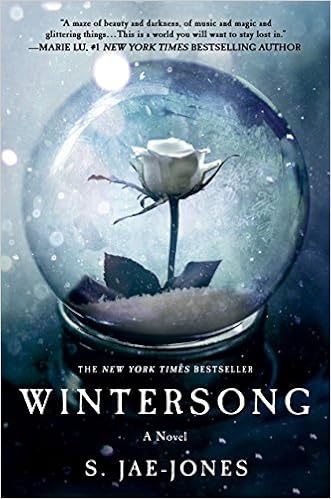
Book Review: Wintersong by S. Jae-Jones
This is the best book I've read in months!
It was released at the same time as Caraval, which got all the hype and was .... postmodern. But this! Wow!
The author has taken Christina Rossetti's poem "Goblin Market" (She even names the protagonist Elizabeth, like Rossetti) and mixed it with Goethe's and Schubert's "Der Erlkönig," throwing in the myth of Persephone and just a titch of Labyrinth with her unnamed Goblin King of "austere" (most over-used word in the book) beauty and "thistledown" hair looking all-too-much like David Bowie as Jareth. But all of this is woven so skillfully together!
I devoured this book.
The characterization is strong: Liesl/Elizabeth is a feminist character who does not need saving by a man; her goal is to save her siblings. She isn't pretty, which is a nice change. She does not spend the whole book looking for a man, and, even though her unsurprising romance is a major part of the book, it is not what "makes" her as a person.
The setting is good, with enough historical touches thrown in to make it feel real. (There is that anachronistic weirdness of what appears to be a Medieval monk teaching the Goblin King to play the violin, however. ) And the plot is multi-layered with several surprises.
I thought at first it was a stand-alone, as the ending is fabulous and should really be the final end. But then I noticed that the tiny subplot of the grandmother and the Goblin King is never worked out thoroughly, that Liesl never resolves things with her emotionally manipulative father, and that her brother's conflicts are left hanging. Therefore, in spite of the fact that Liesl's main conflicts have been resolved and she's in a good place (as is her sister), I'm guessing there will be a sequel to bring a cheesier ending; I just hope it doesn't spoil the goodness of this one.
If you feel like reading a modern fairy tale that feels as old as the Grimm Brothers' tales, try this. It is magic sliced into a novel.
I borrowed this book from the public library, but it's so good that I'm going to buy a copy to keep!
Subscribe to:
Posts (Atom)