Today Twitter went nuts over a Washington Post article about our "Christian" VP Mike Pence and his "Prayer Warrior" wife Karen. It seems the article reminded everyone that Pence had once declared that he never eats a meal alone with a woman who is not his wife and that he will not attend events with alcohol unless she is there with him.
His fan club, conservatives, and other regressives jumped on this to lash out at progressives, liberals, and Democrats, saying that no one is allowed to be negative about the fact that Pence is faithful to his wife. They contrast him to trump (lack of capitalization is not an error), saying that #45 is sexist with his "grab them by the pussy" remarks, but that Pence is just being a good "Christian" husband.
I say they're both sexist and both attitudes are equally harmful to women.
You see, I'm entirely too familiar with the Pence brand of benevolent sexism disguised as Christian devotion and fidelity to marriage vows. Mormons are really big on 1 Thessalonians 5:22 "Abstain from all appearance of evil." Mormon men are never supposed to be alone with a female who is not their wife or near relative. They are required to go in pairs when paying official visits to women, giving blessings, doing acts of service, etc. There are strict rules about other men being nearby when a woman needs to have a confidential chat with her bishop.
I've known LDS male school principals who were extremely uncomfortable when a female staff member closed the office door to talk to them without being overheard. I know single/divorced women whose assigned Home Teachers (men who are supposed to check up on members' well-being monthly) refused to enter their home (would only speak to the woman from her front porch) or refused to visit at all (even with their partners). I know an unmarried woman who purposely asked for the assistance of an unmarried man, yet he refused to be alone with her during the time it took to give her a blessing (some 10 minutes or so).
I was so used to this that I perceived it as somehow normal -- until I lived in Scotland, where Mormons are few and far between. Male university professors there met with female students one-on-one without fear or shame. The window washer for my dorm did not feel the need to prop the door open when he spent 3 minutes in my room with me while cleaning the window. Male students met with female students for study groups -- and they studied. Imagine that.
Yes, our 45th President is a sexist pig who thinks it's OK to grope and grab women he finds attractive and to belittle those he finds unattractive. This is overt sexism. It reduces women to objects of male gratification and all men to potential sex offenders.
But Pence's benevolent sexism is no different. It presumes that all women are either sluts or temptresses and that men cannot control themselves around them. Women are still objects; men are still all potential rapists.
Just because Pence is only on wife #1 doesn't mean he's any more likely to value women than trump is. And Pence's record of controlling and demeaning women's rights bears that out.
Pence may be monogamous, but that doesn't mean he's not sexist.
UPDATE 4/1/17: This is an excellent article on this subject.
Showing posts with label Feminism. Show all posts
Showing posts with label Feminism. Show all posts
Thursday, March 30, 2017
Sunday, January 22, 2017
What Do We Do Now?
The least-popular president of the US has now been sworn in. Already he has shown signs of behaving like a dictator. I know several people who (half)joke that he'll be struck down by an assassin, an illness, or the Hand of God. But that would leave us with 1) Mike Pence, 2) Paul Ryan, and 3) (heaven help us all) Orrin Hatch. It would also still leave us with a Cabinet full of KKK supporters and extremely unfit people. (DeVos is anti-public education and seems to think it's common for grizzly bears to attack schools.)
In the vernacular of my students, we're screwed.
Or maybe not.
Yesterday, several million people -- mostly women -- protested against this dangerous man and his hateful officials. This made it clear that those who fear this evil ARE NOT ALONE.
This is good.
But what do we DO now? Clearly, one vast protest is not enough to get things to change.
I am suggesting this website. It gives clear ideas and a great deal of help as to what we can do to help bring about change.
In the vernacular of my students, we're screwed.
Or maybe not.
Yesterday, several million people -- mostly women -- protested against this dangerous man and his hateful officials. This made it clear that those who fear this evil ARE NOT ALONE.
This is good.
But what do we DO now? Clearly, one vast protest is not enough to get things to change.
I am suggesting this website. It gives clear ideas and a great deal of help as to what we can do to help bring about change.
Friday, October 7, 2016
In Which I Rant Against Benevolent Patriarchy And Everyday Sexism
Warning: Rant Ahead. Do not read if you cannot handle feminism (i.e. the belief that women are people too).
Right now, I'm not disgusted with Trump after the leak of this video clip wherein he talks about married women as objects. After all, why is that really so much worse than all the rest of his talk about women? I think we all know what he thinks of women.
No, what's angering me right now is all these self-righteous men who've suddenly declared Trump over the line because of his comments about married women. Apparently, to them it was OK when he called other women bimbos and fatties and various other words that I think I won't type just now.
Get this tweet:
Right now, I'm not disgusted with Trump after the leak of this video clip wherein he talks about married women as objects. After all, why is that really so much worse than all the rest of his talk about women? I think we all know what he thinks of women.
No, what's angering me right now is all these self-righteous men who've suddenly declared Trump over the line because of his comments about married women. Apparently, to them it was OK when he called other women bimbos and fatties and various other words that I think I won't type just now.
Get this tweet:
Mitt Romney Verified account
@MittRomney
Hitting on married women? Condoning assault? Such vile degradations demean our wives and daughters and corrupt America's face to the world.
So lovely Mr. Morality Mittens is shocked... shocked! at Trump. But notice that Mitt uses POSSESSIVE ADJECTIVES about women? "OUR wives and daughters." Obviously, he's talking to MEN in this tweet -- because it's the MEN who OWN these wives and daughters who should be shocked! Mittens Dearest doesn't actually acknowledge women in this tweet -- because they are objects and cannot feel.
Benevolent patriarchy is just as sickening as Trump's sexist remarks. I loathe Trump, but at least he admits he has no real respect for women; he's fairly up front about it. Mitt, however, clearly thinks he's on higher moral ground because he doesn't use "vile" words; he doesn't even realize that speaking about women as objects owned by men is sexist and repulsive.
Then there's wimpy Gov. Gary Herbert. He just tweeted that he is shocked... shocked!... by Trump. And he will not vote for him. But in the same tweet, he says he cannot vote for Hillary. Of course not. After all, she IS a woman! Gasp!
So, he'll vote for some libertarian wacko ... and the vote will help Trump. Disgusting. He can't bring himself to vote for the most qualified candidate we've had in ..... well, really EVER (who else has been a senator, Sec. of State, AND a President's wife to see the ups and downs of the office? NO ONE else who's ever run)... because she's a woman. Oh, and a Democrat. Her other sin.
Sexist crap.
I'd seriously rather listen to Trump's sick tape than listen to these hypocrites pretend they're better that Trump because they don't use ugly words against women, when if fact they are clearly putting themselves above women anyway.
End rant.
@MittRomney
Hitting on married women? Condoning assault? Such vile degradations demean our wives and daughters and corrupt America's face to the world.
So lovely Mr. Morality Mittens is shocked... shocked! at Trump. But notice that Mitt uses POSSESSIVE ADJECTIVES about women? "OUR wives and daughters." Obviously, he's talking to MEN in this tweet -- because it's the MEN who OWN these wives and daughters who should be shocked! Mittens Dearest doesn't actually acknowledge women in this tweet -- because they are objects and cannot feel.
Benevolent patriarchy is just as sickening as Trump's sexist remarks. I loathe Trump, but at least he admits he has no real respect for women; he's fairly up front about it. Mitt, however, clearly thinks he's on higher moral ground because he doesn't use "vile" words; he doesn't even realize that speaking about women as objects owned by men is sexist and repulsive.
Then there's wimpy Gov. Gary Herbert. He just tweeted that he is shocked... shocked!... by Trump. And he will not vote for him. But in the same tweet, he says he cannot vote for Hillary. Of course not. After all, she IS a woman! Gasp!
So, he'll vote for some libertarian wacko ... and the vote will help Trump. Disgusting. He can't bring himself to vote for the most qualified candidate we've had in ..... well, really EVER (who else has been a senator, Sec. of State, AND a President's wife to see the ups and downs of the office? NO ONE else who's ever run)... because she's a woman. Oh, and a Democrat. Her other sin.
Sexist crap.
I'd seriously rather listen to Trump's sick tape than listen to these hypocrites pretend they're better that Trump because they don't use ugly words against women, when if fact they are clearly putting themselves above women anyway.
End rant.
Sunday, August 30, 2015
Book Review: Silver In The Blood by Jessica Day George

Society girls from New York City circa 1890, Dacia and Lou never desired to know more about their lineage, instead preferring to gossip about the mysterious Romanian family that they barely knew. But upon turning seventeen, the girls must return to their homeland to meet their relatives, find proper husbands, and—most terrifyingly—learn the deep family secrets of The Claw, The Wing, and The Smoke. The Florescus, after all, are shape-shifters, and it is time for Dacia and Lou to fulfill the prophecy that demands their acceptance of this fate... or fight against this cruel inheritance with all their might.
With a gorgeous Romanian setting, stunning Parisian gowns, and dark brooding young men, readers will be swept up by this epic adventure of two girls in a battle for their lives.
So, George is a Utah author, but she's mostly written MG stuff. When The King's English bookstore advertised she was doing a signing for this book, I really wanted to go. But then I read some Amazon reviews, and thinking back to the last three local authors I've supported at TKE wherein it turned out the books were pretty crappy, I decided not to chance it.
This was a bad move because Silver in the Blood is pretty dang good.
Reviewers who influenced me wrongly said things like, "the author choose a way of writing that slowed the book and made it drag " and "This drag and repetition was especially noticeable because the narrative rotated between formats: letters, journal entries, telegraphs, newspaper notices and traditional story structure."
When I finally got the book from our school library and opened it to page one, I felt like shouting at these imbecile reviewers. The idiots had completely missed the point: Jessica Day George, in writing a book about a Romanian family who has the hereditary role of serving the Dracula family, has set up the book like Dracula. Duh.
It doesn't "drag." The dual points of view are not repetitive.
What these uneducated reviewers missed is that Dacia and Lou echo Lucy and Mina in Stoker's original. They are confused and kept in the dark by those who wish them to be in powerless positions. The reader is meant to know more than the girls do; it's called "dramatic irony." (Even Shakespeare used it; don't assume George is the one who doesn't know what's going on here.) Silver in the Blood is set up with multiple points of view and partly in epistle form because it alludes to Dracula. If the reader is too stupid to realize this, it is not the author's fault. It is not the author's fault if the reader is too under-educated to understand dramatic irony, multiple points of view, and literary allusions. (Note: do not even try to argue that the book is YA and that kids aren't exposed to these things, for all three are standard in the junior high curriculum.)
This whole thing reminds me of a quote I once saw in a Readers' Digest (decades ago), "It requires wisdom to understand wisdom; the music is nothing if the audience is deaf."
That being said, I will also state that the book is not five-stars, in my opinion. There were grammatical errors and modernisms in the dialogue that would simply not have occurred among the British upper crust in the 1890s. And there is one whole scene where Dacia, the stronger of the two protagonists, does not defend herself when she is quite capable of doing so and it is in her personality to do so. The whole purpose of her not defending herself appears to be because it allows the plot to move forward, but it's completely out of character for her. That I did not like much.
However, it is still an excellent book and well worth the read.
I enjoyed much of the detail about Romania that the author includes. It feels a bit strained, however, and it's clear that she's writing from recent research and not from long-term knowledge. (For example, her description of Romanian folk dress is accurate to a point, but she seems unaware of the more elaborate variations on the costume for the girls and she neglects to describe the men's folk dress in any detail. Since I've done Romanian folk dance for decades, met many Romanians at festivals when they were in costume, and own two Romanian dresses from this region, I can pick out these details. Nevertheless, I like the fact that she at least did some research.)
The feminism of so many of the male characters in the book is anachronistic, but I liked it. This book gets a thumbs up from me on showing girls thinking for themselves and solving problems.
Overall, I'd give it 4 stars. It's appropriate for about age 13 and up.
(The book feels like it needs a sequel, but I read on Goodreads that George hopes only to write a "companion novel.")
Update: 5:30 PM.
The author sent me this tweet:
 Jessica Day George
Point taken, and I should have recalled they were American (I read the book a week ago.). But I still think the upper crust would have used correct grammar.
Nevertheless, I urge readers to judge for themselves.
Monday, August 17, 2015
Book Review: Uprooted by Naomi Novik
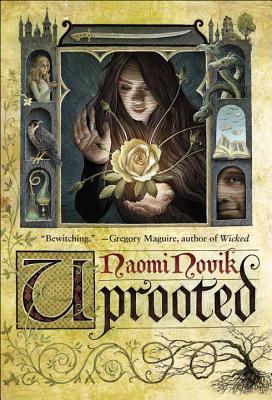
After reading this book I know why; it's Tolkien-based.
Don't get me wrong; it's a very good book. But I am left with the distinct impression that the author's process went something like this:
Why did Old Man Willow encase the hobbits in the first place? Why would a tree do that?
What if Tom Bombadil were a sexy, taciturn wizard instead of an immortal hillbilly in yellow boots?
What is Goldberry's story? And what if she were the daughter of the Old Forest instead of the River's Daughter?
And what if more women in Tolkien besides Eowyn had active roles instead of passive ones? What if Tolkien weren't so into benevolent patriarchy anyway?
What is the history of The Old Forest?
Answer these questions, throw in Baba Jaga so it doesn't sound all Tolkien, put in some Polish names, and you've got Uprooted.
Although it's not particularly original, it's well done. It's rather like discovering that pieces from one puzzle can form a different picture if you put them together in a new way.
The characterization is superb, the pacing is good, and the plot works decently (although predictably).
I am most pleased with how good a book this is for girls. The protagonist (who has a long and unpronounceable name -- why would an author do that?) is a terrific role model for girls. She's truly a "strong female character," but not in physical strength. She matures a great deal in the book. And better yet, about half of the strong, important characters are women (both for good and for bad!). I loved this.
Her friendship with Kasia works well, and the book is not JUST about romance with the sexy wizard.
One caution: there is one attempted rape scene, one almost sex scene, and one sex scene. These are not gratuitous, but are integral to the plot. However, this book might not be appropriate for very sensitive or young kids. (I probably wouldn't give it to anyone younger than 12, but that's just my opinion.) It's also not appropriate for overly-sensitive parents.
But overall, this is a very good book, and I definitely recommend it.
Thursday, December 4, 2014
The New York Post Ranks Utah Right Up There With Saudi Arabia For Women
A couple of days ago, the New York Post ran an article entitled "Five Places Women Shouldn't Spend Their Travel Dollars." In the article, Utah was lumped with Turkey, El Salvador, Indonesia, and Saudi Arabia for places horrible for women -- and the writer didn't even take into account our 3rd-world birthrate, polygamous groups, and patriarchal socio-religious dominating influence!
Here's what she had to say about each place a woman should avoid, due to the severe lack of rights for women there.
Turkey:
Indonesia:
As if being a policewoman weren’t tough enough, in Indonesia, a report says the government forces female recruits to undergo “virginity tests,” which involves a doctor examining applicants to see if their hymens are intact. The reason? Policewomen in Indonesia are required to be virgins, to ensure that they are morally fit for duty.
El Salvador:
...[T]he country also has some of the world’s strictest anti-abortion laws — abortion is illegal for any reason, including rape, incest or when the mother’s life is in danger. A side effect is that women who suffer miscarriages or stillbirths have been accused of trying to end their pregnancies — and have been sentenced to prison for aggravated homicide, a charge that carries up to 30 years. A 2012 report from the Central American Women’s Network listed 628 El Salvadoran women currently imprisoned for having abortions, and noted that “women . . . are regularly reported to the police following a miscarriage, stillbirth or premature labour.”
Saudi Arabia:
Last week, numerous restaurants posted signs banning single women from entering. Why? Because they smoke, “flirt” and speak on their cellphones — behavior that one restaurant owner called “mentally unstable.” It’s just one of a long list of things women are prohibited from doing by law in Saudi Arabia. Those include: voting, driving, and visiting a doctor without a male chaperone.
Utah:
*****
Well, when she puts it that way, she does have a point.
Here's what she had to say about each place a woman should avoid, due to the severe lack of rights for women there.
Turkey:
“You cannot bring women and men into equal positions; that is against nature because their nature is different.” So said Turkey’s president Recep Tayyip Erdogan, speaking last week in Istanbul at — of all places — a women’s conference. In the speech, delivered on Nov. 24 to the Turkish Women and Democracy Association, Erdogan indicated that a woman is incapable of doing every job that a man can do because “it is against her delicate nature” — specifically citing pregnant women and nursing mothers.
“You can’t tell this to feminists, because they do not accept motherhood. They have no such concerns,” said the conservative leader, who’s advocated for women having at least three children. We wonder what Beyoncé would have to say about that.
Indonesia:
As if being a policewoman weren’t tough enough, in Indonesia, a report says the government forces female recruits to undergo “virginity tests,” which involves a doctor examining applicants to see if their hymens are intact. The reason? Policewomen in Indonesia are required to be virgins, to ensure that they are morally fit for duty.
El Salvador:
...[T]he country also has some of the world’s strictest anti-abortion laws — abortion is illegal for any reason, including rape, incest or when the mother’s life is in danger. A side effect is that women who suffer miscarriages or stillbirths have been accused of trying to end their pregnancies — and have been sentenced to prison for aggravated homicide, a charge that carries up to 30 years. A 2012 report from the Central American Women’s Network listed 628 El Salvadoran women currently imprisoned for having abortions, and noted that “women . . . are regularly reported to the police following a miscarriage, stillbirth or premature labour.”
Saudi Arabia:
Last week, numerous restaurants posted signs banning single women from entering. Why? Because they smoke, “flirt” and speak on their cellphones — behavior that one restaurant owner called “mentally unstable.” It’s just one of a long list of things women are prohibited from doing by law in Saudi Arabia. Those include: voting, driving, and visiting a doctor without a male chaperone.
Utah:
Basing its tabulation on three major categories — economy, leadership and health — 247wallst.com came to the conclusion that “Utah is the worst state for women.” Here are just a few reasons: A typical man in Utah earned more than $50,000 in 2013, while most women made 70 percent of that figure — one of the largest gender-pay gaps in the nation. Less than 31 percent of management positions were held by women in Utah (the second lowest rate in the US). Only six women occupy the 75 seats in the state’s House of Representatives, and Utah has just five female state senators — a huge underrepresentation of women in government.
For its rankings, wallethub.com took 10 key metrics into account and declared Utah 49th in gender-based disparity. Among its findings: Utah had the biggest educational attainment gap and was second to last in workplace equality.
*****
Well, when she puts it that way, she does have a point.
Tuesday, October 28, 2014

Sunday, April 6, 2014
Frozen vs. Brave: What Are Disney's Messages Now?
In years past, Disney's messages have pretty much been things like "girls get married and boys have adventures." Take Snow White, for example. The princess is young (did you know she's only 14?), pretty, and inexplicably good at housekeeping -- for a princess. Basically, she has to be passive and sweet, cleaning and hanging out with animals, while under the protection of non-sexual men (the dwarves are short and goofy, so this -- naturally -- makes them non-sexual beings *eye roll*) and wait while the prince fights off her evil step-mother and then claims her as a prize for his efforts. Fast-forward five decades to The Little Mermaid. Ariel is less passive, and Prince Eric is more so, but the whole point of the movie is that the girl changes her life, her body, her home, and her whole lifestyle in order to be accepted by the guy. He merely has to accept her and change nothing about himself. Then, in Beauty and the Beast and Aladdin, we do get a bookish princess and -- oh my gosh! -- a brown princess, but the whole message here is "Girls, if you're good and sweet enough, you can change an abusive man or a worthless one into the right kind of husband." Groan. Then people praised The Frog Princess and Tangled for being so "modern." But the whole point is still the same as in Beast and Aladdin, although we do get a Black princess for a change.
Then Brave happened. And the Wonderful World of Disney finally changed.
Frozen is also keeping right on track, and some folks say it's even better.
Let us compare.
Both movies actually have women dealing with problems that are not about men. In Brave, it's the mother-daughter relationship that drives the central conflict, and in Frozen, it's Elsa's problems with herself and with her sister. Score: one point for each movie.
Princess Merida in Brave is (in the movie, anyway) more ordinary in looks and actions. She is cute but not beautiful. She tromps rather than gliding. She is strong, likes archery, mountain climbing, and her horse. She is not at all passive. She also prefers practical clothing and natural hair. She is a princess who appeals to little boys as much as to little girls. In contrast, Elsa in Frozen is at first reserved and beautiful and then sexy and beautiful. True, she gets to do spiffy stuff with ice, but she's struggling with internal conflicts and doesn't do anything to appeal to adventuresome boys and girls. Anna is funny and more adventuresome, but she's still way too perfectly pretty. Only once in the whole movie does she look anything other than lovely and graceful (the bed-head scene). Score: Brave 2, Frozen 1.
Neither movie has very many women in it. Brave has only 4 important women, and in Frozen, there are the two sisters, with briefly their mother and a couple of female trolls. Both movies are about a few women dealing with a men's world. Hmm... However, Brave at least shows the three traditional aspects of women: maiden, mother, wise woman (OK, so she's a goofy wise woman), all of whom work together to solve the problem of family love and respect. Frozen doesn't really have any generational stuff going on. Score: Brave still 2, Frozen loses a point to be 0.
Now let's consider what each movie teaches about love.
In Brave, Merida's insists that 16 is too young for marriage. (Hooray! It's about time, Disney!) She also declares -- and her mother finally agrees -- that young people should choose for themselves, in their own time. In the end, Merida is seen at least accepting a kiss on the hand from the most promising of the young suitors (the one who speaks the Doric, and who is pretty dang hard to understand), showing that she'll be willing to think about acceptable guys when she's ready. (Then she rides off to have adventures with her mom -- because the time for romance is NOT 16.) In Frozen, we have that wonderful moment when Elsa tells us all that you can't marry a man you just met. (Hooray for Disney!) Unfortunately, this wisdom is completely undermined when romantic love and the fake-marriage of Anna to Kristof occurs within just a few more days. So, Disney's telling us.... uh... you can't marry the wrong guy if you just met him, but you can marry the right guy. What the crap?! Oh, sure, Anna doesn't actually marry him by the end of the movie, but it's clear they're completely paired off. Score: Brave +1 for a total of 3, Frozen + 1 then - 1 for 0.
So what do the movies have to tell us about men? Let's look at that.
Brave: Dad and Mom are totally in love with each other and love their kids very much. Awwww. Cute. However, over and over again, we are shown that men are warlike and can't control themselves without a woman there to calm them down. Boo. Hiss. That's no message to give either girls or boys! Making women responsible for men's actions is totally not cool. In Frozen we have Dad and Mom who are pretty concerned for their children's welfare, but they're more obsessed with public image than anything else. Not great. We also learn that you really don't know whether to trust men or not. It's obvious we shouldn't trust the merchant of Weaseltown, but Prince Hans is just as charming and sweet as can be -- until we learn his true motives. Oaken is also totally sweet until his temper flares up. So, how can we possibly trust Kristof? How do we know, without giving him some time to show his true colors, whether or not he's the good guy? Uh, well, we know because Disney says so. OK, right. Whatever. So, don't trust men. Unless... unless something. What? This makes no sense. Score: Brave -1 for a score of 2 and Frozen -1 for a score of -1.
Brave teaches us that parents can love each other romantically and in a friendly way. It also shows the huge importance of parents and all children (Merida and her little brothers love each other) working together to keep the family going. Yes! There's also no sense of Merida's having to give up her family or change herself just to get a man, like Ariel does in Mermaid. In fact, it's pretty clear that Merida's not going to change herself for any man. Well played, Disney.
In Frozen, however, we have a broken family trying to mend itself. The parents have stifled love and joy in the family until Anna, as Hans truly tells us, is so desperate for love she'll take the first person who pays attention to her -- and apparently also the second, as she takes to Kristof mighty fast as well. Poor Elsa is completely damaged, but love is the answer! Yes, as soon as she realizes love can thaw things, she does. Even though this makes no sense. How did she learn to love? Yes, she loves her sister, but Elsa's barely beginning to accept herself. How can she suddenly and completely reverse all the damage done to her and her country just by saying that love is the answer? Merida takes a whole freakin' movie to understand that she loves her mother and needs to work things out with her. How can Elsa heal years of abuse (which Merida did not have) in a few seconds? Love, in Frozen, is presented as some kind of magic spell, rather than as something people have to work on and work out.
Score: Brave +1, for a total of 3, and Frozen + 0, for a total of -1.
There you have it, folks. Disney has come a long way from the pathetically passive princesses of the past (here, have some alliteration, OK?), but Brave is still better than Frozen at teaching life lessons to kids.
(Plus, dude, it's set in SCOTLAND, for crying out loud. Norway's cool and all, but you just can't top Scotland. :D)
Then Brave happened. And the Wonderful World of Disney finally changed.
Frozen is also keeping right on track, and some folks say it's even better.
Let us compare.
Both movies actually have women dealing with problems that are not about men. In Brave, it's the mother-daughter relationship that drives the central conflict, and in Frozen, it's Elsa's problems with herself and with her sister. Score: one point for each movie.
Princess Merida in Brave is (in the movie, anyway) more ordinary in looks and actions. She is cute but not beautiful. She tromps rather than gliding. She is strong, likes archery, mountain climbing, and her horse. She is not at all passive. She also prefers practical clothing and natural hair. She is a princess who appeals to little boys as much as to little girls. In contrast, Elsa in Frozen is at first reserved and beautiful and then sexy and beautiful. True, she gets to do spiffy stuff with ice, but she's struggling with internal conflicts and doesn't do anything to appeal to adventuresome boys and girls. Anna is funny and more adventuresome, but she's still way too perfectly pretty. Only once in the whole movie does she look anything other than lovely and graceful (the bed-head scene). Score: Brave 2, Frozen 1.
Neither movie has very many women in it. Brave has only 4 important women, and in Frozen, there are the two sisters, with briefly their mother and a couple of female trolls. Both movies are about a few women dealing with a men's world. Hmm... However, Brave at least shows the three traditional aspects of women: maiden, mother, wise woman (OK, so she's a goofy wise woman), all of whom work together to solve the problem of family love and respect. Frozen doesn't really have any generational stuff going on. Score: Brave still 2, Frozen loses a point to be 0.
Now let's consider what each movie teaches about love.
In Brave, Merida's insists that 16 is too young for marriage. (Hooray! It's about time, Disney!) She also declares -- and her mother finally agrees -- that young people should choose for themselves, in their own time. In the end, Merida is seen at least accepting a kiss on the hand from the most promising of the young suitors (the one who speaks the Doric, and who is pretty dang hard to understand), showing that she'll be willing to think about acceptable guys when she's ready. (Then she rides off to have adventures with her mom -- because the time for romance is NOT 16.) In Frozen, we have that wonderful moment when Elsa tells us all that you can't marry a man you just met. (Hooray for Disney!) Unfortunately, this wisdom is completely undermined when romantic love and the fake-marriage of Anna to Kristof occurs within just a few more days. So, Disney's telling us.... uh... you can't marry the wrong guy if you just met him, but you can marry the right guy. What the crap?! Oh, sure, Anna doesn't actually marry him by the end of the movie, but it's clear they're completely paired off. Score: Brave +1 for a total of 3, Frozen + 1 then - 1 for 0.
So what do the movies have to tell us about men? Let's look at that.
Brave: Dad and Mom are totally in love with each other and love their kids very much. Awwww. Cute. However, over and over again, we are shown that men are warlike and can't control themselves without a woman there to calm them down. Boo. Hiss. That's no message to give either girls or boys! Making women responsible for men's actions is totally not cool. In Frozen we have Dad and Mom who are pretty concerned for their children's welfare, but they're more obsessed with public image than anything else. Not great. We also learn that you really don't know whether to trust men or not. It's obvious we shouldn't trust the merchant of Weaseltown, but Prince Hans is just as charming and sweet as can be -- until we learn his true motives. Oaken is also totally sweet until his temper flares up. So, how can we possibly trust Kristof? How do we know, without giving him some time to show his true colors, whether or not he's the good guy? Uh, well, we know because Disney says so. OK, right. Whatever. So, don't trust men. Unless... unless something. What? This makes no sense. Score: Brave -1 for a score of 2 and Frozen -1 for a score of -1.
Brave teaches us that parents can love each other romantically and in a friendly way. It also shows the huge importance of parents and all children (Merida and her little brothers love each other) working together to keep the family going. Yes! There's also no sense of Merida's having to give up her family or change herself just to get a man, like Ariel does in Mermaid. In fact, it's pretty clear that Merida's not going to change herself for any man. Well played, Disney.
In Frozen, however, we have a broken family trying to mend itself. The parents have stifled love and joy in the family until Anna, as Hans truly tells us, is so desperate for love she'll take the first person who pays attention to her -- and apparently also the second, as she takes to Kristof mighty fast as well. Poor Elsa is completely damaged, but love is the answer! Yes, as soon as she realizes love can thaw things, she does. Even though this makes no sense. How did she learn to love? Yes, she loves her sister, but Elsa's barely beginning to accept herself. How can she suddenly and completely reverse all the damage done to her and her country just by saying that love is the answer? Merida takes a whole freakin' movie to understand that she loves her mother and needs to work things out with her. How can Elsa heal years of abuse (which Merida did not have) in a few seconds? Love, in Frozen, is presented as some kind of magic spell, rather than as something people have to work on and work out.
Score: Brave +1, for a total of 3, and Frozen + 0, for a total of -1.
There you have it, folks. Disney has come a long way from the pathetically passive princesses of the past (here, have some alliteration, OK?), but Brave is still better than Frozen at teaching life lessons to kids.
(Plus, dude, it's set in SCOTLAND, for crying out loud. Norway's cool and all, but you just can't top Scotland. :D)
Monday, January 27, 2014
Best And Worst Literary Role Models For Girls
A few days ago, I posted on Alan Bradley's Flavia DeLuce series and how Flavia is a superb role model for girls. But that post got me thinking about other books, including some I loved as a child which really send girls awful messages. Thus, I decided to put together lists of good and bad role models for girls in fiction.
However, this is a work in progress. I'd love to hear your suggestions and thoughts in the comments section.

Here are my lists so far:
What do you think? Have anything to add? What have I forgotten? (I'm thinking about Pippi Longstocking, but I need to reread the books first to be sure. I ought to consider Katniss, but I disliked Hunger Games so much that I quit reading after about 70 pages of it, so I can't be sure of her messages to girls after that.)
However, this is a work in progress. I'd love to hear your suggestions and thoughts in the comments section.

Here are my lists so far:
Best:
- Flavia DeLuce from The Sweetness at the Bottom of the Pie series by Alan Bradley. Intelligence, self-motivation, determination, bravery, willingness to go alone, carefulness not to trust too many people
- Jane from Devilish by Maureen Johnson. Loyalty, bravery, saving your friend is more important than winning the guy.
- Annabelle in Freaky Friday by Mary Rogers. Your relationship with your mom is important. Intelligence, humor, spunk. And when you’re mature enough, you’ll see that doing well in school is very important; it’s only immature girls who think it’s not.
- Sophronia in the Etiquette and Espionage series by Gail Carriger. Intelligence, spunk, resourcefulness, courage, doing your job is more important than getting the guy.
- Deryn in the Leviathan series by Scott Westerfeld. Courage, self-dependence, intelligence, not just waiting around being sweet, believing in who you are.
- Elisa in the Girl of Fire and Thorns series by Rae Carson. Courage, intelligence, not every man is worthy of you, independence, don’t leave making babies to chance, leadership. Unfortunately, there is also the very strong message of “lose weight to get a man.”
- DJ in Dairy Queen by Catherine Murdock. It’s okay if you’re not feminine and pretty. Being true to yourself is more important.
- Puck in the Scorpio Races by Maggie Stiefvator. Independence, courage, family, feminism. Life isn’t just about getting the hot guy.
- Elizabeth in Pride and Prejudice by Jane Austen. Don’t take just anybody. Oh, and wait until you both grow up first.
- Kivrin in The Doomsday Book by Connie Willis. Intelligence, courage, self-motivation. Yes, she gets “saved” by a man at the end, but 1) he’s a father-figure, not a boyfriend, and 2) it’s clear she’d survive in the past just fine if she had to stay there on her own.
- Laura Ingalls Wilder, writing about herself. Yes, she marries at 18. But she doesn’t spend the whole of her young years focusing just on Almanzo. She’s intelligent, brave, and independent - teaching school at 16.
- Beatrice in Much Ado About Nothing by William Shakespeare. Intelligent, funny, independent, loyal. She won’t tolerate a man who doesn’t treat her decently.
- Viola in 12th Night by William Shakespeare. Solve your own problems; don’t wait for men to solve them for you.
- Robin in The Velvet Room by Zilpha Keatley Snyder. Girls can be active and solve mysteries. Plus, reading is good.
- April and Melanie in The Eqypt Game by Zilpha Keatley Snyder. Friendship knows no skin color. Imagination is good. Read! Be brave and solve your own problems.
- Ramona in the Ramona books by Beverley Cleary. Little girls don’t have to be sweet and quiet to be likable and good at heart.
- Cinder in Cinder by Marissa Meyer. Smart, clever, loyal. It’s NOT just about marrying the prince.
- UPDATE: 11/2/14 I just read Harriet, The Spy by Louise Fitzhugh for the first time. Harriet is superb. Bright, honest, and, best of all, she is NOT portrayed as "learning to be nice" as some kind of moral for little girls. No, she is allowed to continue to be her snarky little self. Plus, she gets even with the bullies. Yes!
Worst:
- Wendy in Peter Pan by JM Barrie. Mothering is everything. Expect men to hurt you and cheat on you. Growing up means leaving freedom behind
- Beauty in Beauty and the Beast from Grimm’s Tales. Girls, if you’re good and sweet, you can tame a beast into a man. If you fail, it’s because you’re not loving enough.
- The March sisters in Little Women by Louisa May Alcott. Yes, we all know that Jo shows spunk in the first half, but in the second half, she gives up the man she loves, then takes the only man who pays attention to her, bending herself to meet his wishes by giving up her independence and writing career. Meg is taught to do whatever her husband wants, that she can’t control her own son because he’s a boy, and that her job is to make her husband happy because he knows better about everything -- even when he’s an inconsiderate dolt who brings home unexpected guests for dinner and complains when she’s not perfectly ready for this.
- Sara Crewe in A Little Princess by Frances Hodgson Burnett. Yes, she is kind. But the message is to be sweet and demure, and then -- eventually -- a man will save you. Just wait until that happens.
- Bella Swan in Twilight, etc. by Stephenie Meyer. Wimpy, passive, dependent, victim. The whole series glorifies abusive relationships. Plus, it’s all about catching the right guy and making babies that almost kill you -- but that’s so “glorious.” gag.
- Fanny in Mansfield Park by Jane Austen. Passive and feeble. The whole point is that if a girl is “good” enough and patient, the good man will eventually come to select her. Lies.
- Juliet in Romeo and Juliet by William Shakespeare. Impetuous, drama queen, kills herself after her inability to think before acting on hormonal urges has caused the deaths of 5 other people.
- Hero in Much Ado About Nothing by William Shakespeare. She forgives and marries Claudio in spite of the fact that he values her for nothing other than her money and her virginity, and after he throws a tantrum and shames her in public. Clearly, she deserves the misery she’ll get with this guy, but that’s no reason for a modern girl to find this romantic.
- Both Catherines and Isabella in Wuthering Heights by Emily Bronte. They all fall in love with jerks, two of them the same jerk. Isabella is stupid and passive. The two Catherines are spoiled little divas.
- Lucy Manette in A Tale of Two Cities by Charles Dickens. Beauty and passivity are all that matters in life.
- Cassia in the Matched series by Ally Condie. Sure, you can have adventures, but remember that the whole point is to marry the “right” guy.
- Scarlet in Scarlet by Marissa Meyer. Glorifies abusive relationships.
What do you think? Have anything to add? What have I forgotten? (I'm thinking about Pippi Longstocking, but I need to reread the books first to be sure. I ought to consider Katniss, but I disliked Hunger Games so much that I quit reading after about 70 pages of it, so I can't be sure of her messages to girls after that.)
Saturday, January 18, 2014
An Awesome Literary Role Model For Girls: Flavia DeLuce
I grew up reading everything I could get my hands on, from the Little Eddie books and Mary Poppins series to the Three Investigators series to a biography of Rose Kennedy my mother had picked up for some book club and Chariot of the Gods, which was left behind by one of my parents' friends (and which, even at age 8, I thought was far-fetched). But the books that really influenced my concept of a woman's role in society were Little Women, A Little Princess, and Rebecca of Sunnybrook Farm.
Now, I still believe that these are well-written books and that kids ought to read them, but I hope that girls today would internalize other messages about girls, rather than things like "be good and obedient and wait for a man to rescue you" (Sarah Crewe) or "writing is OK, as long as you don't write about anything popular where you might earn money and become independent and damage your reputation" (Jo March).
 (Photo: the first five Flavia DeLuce novels.)
 (Photo: the sixth Flavia novel, released on 1/14/14.)
Far better for girls today is Flavia DeLuce.
Now, Alan Bradley, author of the Flavia series, has admitted that he's not trying to write YA. He tells on his website that Flavia popped into his head while he was trying to write a completely different work, and he knew he had to write about her. That will explain why Flavia is not like most YA heroines. She is not out looking for a boyfriend. She's not concerned about peer pressure. She's not particularly interested in fashion. Wow. Right there we're onto something fresh.
But it goes beyond what the books are not. In Flavia, Bradley has -- likely accidentally -- created a superb role model for young girls. Flavia is intelligent, self-motivated, brave, and independent. Her messages to girls have nothing to do with waiting/looking for a man or being obedient and submissive to social expectations for women.
The entire series of novels celebrates intelligence, and Flavia is at the head of all other smart characters in the books. All the books highlight intelligence as desirable, for it is the smart characters that solve crimes and look good in the eyes of others. Flavia's next older sister, Daphne (called "Daffy" by Flavia), is a bookworm obsessed with Dickens. Flavia treats her as a 1950s version of Google, seeking her out for historical questions. Dogger, Flavia's father's friend from the War who serves as a jack-of-all-trades at the family mansion, Buckshaw, but who also is more of a father to Flavia than her own dad is, has vast amounts of medical knowledge hiding in his shattered-by-PTSD mind. Dr. Kissing, Flavia's father's former schoolmaster, is also a source of information for her. And Inspector Hewitt, the police officer most likely to deal with Flavia, is -- although not brilliant -- an intelligent man whom Flavia respects. Also, throughout the series, we are ever reminded that Flavia's missing mother Harriet was intelligent, and hints are dropped that Aunt Felicity (Father's sister) is one sharp cookie cutter.
But Flavia outdoes them all. (Of course, for she is our protagonist!) She is clearly a gifted child -- emphasis on BOTH words there. She is rather childlike in many beliefs (she has no idea of what an "affair" is, still believes in Father Christmas, hopes to resurrect the dead) and habits (in one hilarious scene, she scrubs mud off her beloved bicycle Gladys with her toothbrush, then mentions cleaning herself up -- including brushing her teeth! -- in the very next paragraph). But she is brilliant in chemistry! She has read through a whole library of her deceased Uncle Tar's chemistry books, she works out fascinating experiments with the equipment in his lab, and she solves crimes in this way.
Bradley goes into fabulous detail about the experiments, with none of this vague Mary Shelley stuff about "old books." No, step-by-step, Flavia walks us through testing blood (to see if her sisters are lying when they say she's adopted), constructing fireworks, and creating interesting poisons. Along the way, the reader is treated to a great deal of the history of chemical discoveries.
Honestly, I cannot think of a better way to hook a young girl into an interest in chemistry than to let her read these books (or read them WITH her, if she is younger or not a voracious reader). I often find myself wanting to go out and buy a basic chemistry set just to try some of this stuff! And I know the books make me wish I'd taken chemistry in high school. (To my credit, I preferred physiology, and I adored my classes in that subject. But I never took chemistry; it was not a popular class at my high school, and thus, I never even thought about taking it.) In these days where we need women interested in the sciences, Flavia can do a wonderful job of planting that seed into a girl's head. And her fabulous brilliance underscores over and over and over: Girls, being smart is cool and awesome; smart girls are winners. What a fantastic message to a girl --- or to a boy!
Flavia also has a characteristic which I, as a school teacher, find so often lacking in kids: she's self-motivated. No one makes her learn chemistry; she teaches herself. No outside force causes her to solve mysteries; she is driven by her own curiosity. She does her own research, her own experiments, she solves the crimes because she WANTS to. She is NEVER lazy; she bikes or runs everywhere. She never expects anyone to do her work for her.
Other characters reinforce this idea as well. Dogger goes on with his life in spite of his untreatable (at the time) emotional disability. He is shown as respectable, noble, and hard-working, for he never expects anyone to baby him. Flavia's oldest sister, Ophelia (Ophelia Gertrude, in fact, although I haven't quite worked out yet why she has the Hamlet names going; Flavia calls her "Feely."), is a very dedicated pianist and organist. And everything we hear about the long-absent Harriet lets us know that she was always doing something adventurous or important; she never, ever sat and waited for life to happen -- which is probably why her daughter does not.
Bradley never preaches this virtue, but it's subtly worked in to every single plot in a way that it can be internalized. There is no idea of waiting for anyone else to work or learn; it's all about doing it yourself. This is, again, another fabulous thing for a girl (or a boy) to learn.
This segues naturally into the idea of independence. All too often, books for teens show characters who cannot make it without their friends (think: Harry Potter) or, far worse, that a girl's main interest in life should be to find and keep a man (pretty much 99% of books aimed at girls or women). Flavia is refreshingly independent.
Oh yes, she longs for the approval of adults (Inspector Hewitt and his wife, the vicar, Dr. Kissing, and especially her emotionally distant father), she wishes to make friends (with the gypsy girl, with Nalia), and she struggles for six books with the woes of sibling rivalries, so it is made clear that being independent is not without its downsides. But Bradley also shows a truth that is so very often ignored for girls: that, if ANYONE is going to make it in a hard task, s/he has to be willing to go beyond the comfort zone of having "back ups" and strike out as an individual. Flavia often asks others for their expertise, but she never expects -- or even considers expecting -- anyone to work with her; she knows the job is up to her, whether it be tracking a murder suspect, gathering information, or making chemical analyses in her lab.
Because of this outlook, Flavia spends no time at all looking for boyfriends or planning out a marriage for herself. Oh, she clearly has opinions on attractive and/or intelligent men (boys are pretty much so far beneath her emotionally that she barely notices them, but men interest her), but her life is not about finding and keeping a man; her life is about finding herself, having adventures like her mother, saving her family from the taxman, supporting those she loves or wants to help (Dogger, the old gypsy woman, Nalia), and making her own way in life. What better message could you possibly give to a modern girl than "Focus on making yourself the best you can be"? How many women have wasted their lives by working so hard on attracting and keeping a man that they never even figured out who they really were? Far, far too many. But Flavia is not going to be among those women, and she will help young girls realize that they don't need to be counted in that number either.
Flavia is also brave. She climbs into tunnels, visits other towns by herself, walks on the roof, flies in a small plane, deals with kidnappers, questions adults to solve crimes, figures out ways to do things normally barred to children, goes out at night alone, and faces death and corpses. She sometimes feels fear, but she talks herself out of it. She is almost never at a loss for words. She deals with her own mistakes and goes on with life instead of wallowing in her own failure. While her sisters often hide from less pleasant things in life, Flavia faces them. It is she who has worked out effective (and amusing) ways to help Dogger with his "episodes" (his flashbacks to torture at the hands of the Japanese during WWII; he has post-traumatic stress disorder, although it is never given that modern name in the books), she who faces dealing with the mentally deficient Jocelyn, and she who deals with the treatment of gypsies.
Harriet, as well, is presented at brave. She flew her own airplane and went mountaineering in Tibet. And Aunt Felicity is not just some "old" lady. The further the reader goes into the books, the more s/he learns about what this woman has done in her life.
Bravery, then, is reinforced over and over. Flavia is never cowed into submission by society's expectations of women or by men in positions of authority who wish to control her. No, she stands up to everyone who tries to prevent her success because she knows she's brilliant and capable. She lets NO ONE stop her, especially merely because they are older, male, and an authority figure (the police, the vicar, the schoolmaster, the government figures later on). Her self-confidence and her bravery combine with her intelligence to let her earn success in things which are good. (After all, Flavia seeks to solve crimes, not to cause trouble.)
Wow. What young girl shouldn't learn that? In fact, what grown woman shouldn't have that reinforced in her life?
There you have it: the reasons why Flavia DeLuce is a superb role model for young female readers. She's intelligent, self-motivated, independent, and brave. This veteran English teacher highly recommends the whole series. :)
(Just remember, parents, if you buy the books for your daughter, you ought to consider buying chemistry set for later on. And a bicycle. And don't be surprised if your daughter wants to visit England, take a class on old-style film developing, try mountaineering, or ride in a two-seater airplane. These books might just have that effect on her.)
Now, I still believe that these are well-written books and that kids ought to read them, but I hope that girls today would internalize other messages about girls, rather than things like "be good and obedient and wait for a man to rescue you" (Sarah Crewe) or "writing is OK, as long as you don't write about anything popular where you might earn money and become independent and damage your reputation" (Jo March).
Far better for girls today is Flavia DeLuce.
Now, Alan Bradley, author of the Flavia series, has admitted that he's not trying to write YA. He tells on his website that Flavia popped into his head while he was trying to write a completely different work, and he knew he had to write about her. That will explain why Flavia is not like most YA heroines. She is not out looking for a boyfriend. She's not concerned about peer pressure. She's not particularly interested in fashion. Wow. Right there we're onto something fresh.
But it goes beyond what the books are not. In Flavia, Bradley has -- likely accidentally -- created a superb role model for young girls. Flavia is intelligent, self-motivated, brave, and independent. Her messages to girls have nothing to do with waiting/looking for a man or being obedient and submissive to social expectations for women.
The entire series of novels celebrates intelligence, and Flavia is at the head of all other smart characters in the books. All the books highlight intelligence as desirable, for it is the smart characters that solve crimes and look good in the eyes of others. Flavia's next older sister, Daphne (called "Daffy" by Flavia), is a bookworm obsessed with Dickens. Flavia treats her as a 1950s version of Google, seeking her out for historical questions. Dogger, Flavia's father's friend from the War who serves as a jack-of-all-trades at the family mansion, Buckshaw, but who also is more of a father to Flavia than her own dad is, has vast amounts of medical knowledge hiding in his shattered-by-PTSD mind. Dr. Kissing, Flavia's father's former schoolmaster, is also a source of information for her. And Inspector Hewitt, the police officer most likely to deal with Flavia, is -- although not brilliant -- an intelligent man whom Flavia respects. Also, throughout the series, we are ever reminded that Flavia's missing mother Harriet was intelligent, and hints are dropped that Aunt Felicity (Father's sister) is one sharp cookie cutter.
But Flavia outdoes them all. (Of course, for she is our protagonist!) She is clearly a gifted child -- emphasis on BOTH words there. She is rather childlike in many beliefs (she has no idea of what an "affair" is, still believes in Father Christmas, hopes to resurrect the dead) and habits (in one hilarious scene, she scrubs mud off her beloved bicycle Gladys with her toothbrush, then mentions cleaning herself up -- including brushing her teeth! -- in the very next paragraph). But she is brilliant in chemistry! She has read through a whole library of her deceased Uncle Tar's chemistry books, she works out fascinating experiments with the equipment in his lab, and she solves crimes in this way.
Bradley goes into fabulous detail about the experiments, with none of this vague Mary Shelley stuff about "old books." No, step-by-step, Flavia walks us through testing blood (to see if her sisters are lying when they say she's adopted), constructing fireworks, and creating interesting poisons. Along the way, the reader is treated to a great deal of the history of chemical discoveries.
Honestly, I cannot think of a better way to hook a young girl into an interest in chemistry than to let her read these books (or read them WITH her, if she is younger or not a voracious reader). I often find myself wanting to go out and buy a basic chemistry set just to try some of this stuff! And I know the books make me wish I'd taken chemistry in high school. (To my credit, I preferred physiology, and I adored my classes in that subject. But I never took chemistry; it was not a popular class at my high school, and thus, I never even thought about taking it.) In these days where we need women interested in the sciences, Flavia can do a wonderful job of planting that seed into a girl's head. And her fabulous brilliance underscores over and over and over: Girls, being smart is cool and awesome; smart girls are winners. What a fantastic message to a girl --- or to a boy!
Flavia also has a characteristic which I, as a school teacher, find so often lacking in kids: she's self-motivated. No one makes her learn chemistry; she teaches herself. No outside force causes her to solve mysteries; she is driven by her own curiosity. She does her own research, her own experiments, she solves the crimes because she WANTS to. She is NEVER lazy; she bikes or runs everywhere. She never expects anyone to do her work for her.
Other characters reinforce this idea as well. Dogger goes on with his life in spite of his untreatable (at the time) emotional disability. He is shown as respectable, noble, and hard-working, for he never expects anyone to baby him. Flavia's oldest sister, Ophelia (Ophelia Gertrude, in fact, although I haven't quite worked out yet why she has the Hamlet names going; Flavia calls her "Feely."), is a very dedicated pianist and organist. And everything we hear about the long-absent Harriet lets us know that she was always doing something adventurous or important; she never, ever sat and waited for life to happen -- which is probably why her daughter does not.
Bradley never preaches this virtue, but it's subtly worked in to every single plot in a way that it can be internalized. There is no idea of waiting for anyone else to work or learn; it's all about doing it yourself. This is, again, another fabulous thing for a girl (or a boy) to learn.
This segues naturally into the idea of independence. All too often, books for teens show characters who cannot make it without their friends (think: Harry Potter) or, far worse, that a girl's main interest in life should be to find and keep a man (pretty much 99% of books aimed at girls or women). Flavia is refreshingly independent.
Oh yes, she longs for the approval of adults (Inspector Hewitt and his wife, the vicar, Dr. Kissing, and especially her emotionally distant father), she wishes to make friends (with the gypsy girl, with Nalia), and she struggles for six books with the woes of sibling rivalries, so it is made clear that being independent is not without its downsides. But Bradley also shows a truth that is so very often ignored for girls: that, if ANYONE is going to make it in a hard task, s/he has to be willing to go beyond the comfort zone of having "back ups" and strike out as an individual. Flavia often asks others for their expertise, but she never expects -- or even considers expecting -- anyone to work with her; she knows the job is up to her, whether it be tracking a murder suspect, gathering information, or making chemical analyses in her lab.
Because of this outlook, Flavia spends no time at all looking for boyfriends or planning out a marriage for herself. Oh, she clearly has opinions on attractive and/or intelligent men (boys are pretty much so far beneath her emotionally that she barely notices them, but men interest her), but her life is not about finding and keeping a man; her life is about finding herself, having adventures like her mother, saving her family from the taxman, supporting those she loves or wants to help (Dogger, the old gypsy woman, Nalia), and making her own way in life. What better message could you possibly give to a modern girl than "Focus on making yourself the best you can be"? How many women have wasted their lives by working so hard on attracting and keeping a man that they never even figured out who they really were? Far, far too many. But Flavia is not going to be among those women, and she will help young girls realize that they don't need to be counted in that number either.
Flavia is also brave. She climbs into tunnels, visits other towns by herself, walks on the roof, flies in a small plane, deals with kidnappers, questions adults to solve crimes, figures out ways to do things normally barred to children, goes out at night alone, and faces death and corpses. She sometimes feels fear, but she talks herself out of it. She is almost never at a loss for words. She deals with her own mistakes and goes on with life instead of wallowing in her own failure. While her sisters often hide from less pleasant things in life, Flavia faces them. It is she who has worked out effective (and amusing) ways to help Dogger with his "episodes" (his flashbacks to torture at the hands of the Japanese during WWII; he has post-traumatic stress disorder, although it is never given that modern name in the books), she who faces dealing with the mentally deficient Jocelyn, and she who deals with the treatment of gypsies.
Harriet, as well, is presented at brave. She flew her own airplane and went mountaineering in Tibet. And Aunt Felicity is not just some "old" lady. The further the reader goes into the books, the more s/he learns about what this woman has done in her life.
Bravery, then, is reinforced over and over. Flavia is never cowed into submission by society's expectations of women or by men in positions of authority who wish to control her. No, she stands up to everyone who tries to prevent her success because she knows she's brilliant and capable. She lets NO ONE stop her, especially merely because they are older, male, and an authority figure (the police, the vicar, the schoolmaster, the government figures later on). Her self-confidence and her bravery combine with her intelligence to let her earn success in things which are good. (After all, Flavia seeks to solve crimes, not to cause trouble.)
Wow. What young girl shouldn't learn that? In fact, what grown woman shouldn't have that reinforced in her life?
There you have it: the reasons why Flavia DeLuce is a superb role model for young female readers. She's intelligent, self-motivated, independent, and brave. This veteran English teacher highly recommends the whole series. :)
(Just remember, parents, if you buy the books for your daughter, you ought to consider buying chemistry set for later on. And a bicycle. And don't be surprised if your daughter wants to visit England, take a class on old-style film developing, try mountaineering, or ride in a two-seater airplane. These books might just have that effect on her.)
Subscribe to:
Posts (Atom)